
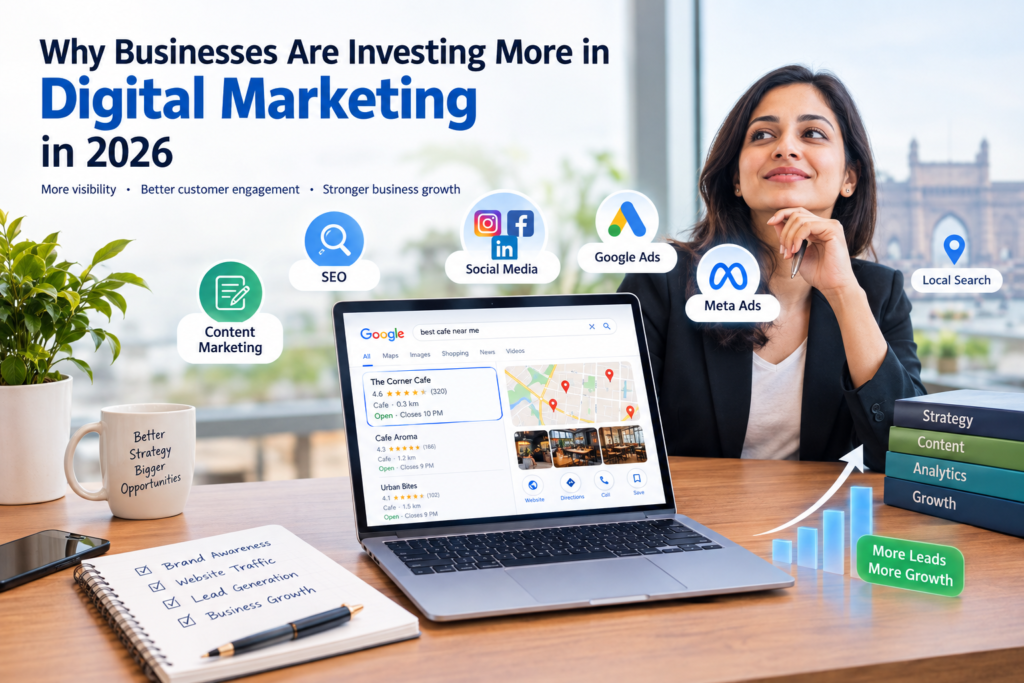
A customer looking for a product or service today may not walk into a shop first. They may search on Google, check reviews, look at social media, visit a website and compare a few businesses before making a decision.
This change in customer behaviour is one of the main reasons businesses are investing more in digital marketing in 2026.
Digital marketing is no longer only about posting on social media or running advertisements. It now covers how a business is found, understood and trusted online.
For a small business owner, this can make digital marketing feel confusing. There are SEO, social media, paid ads, content, local search, AI search and many other areas to consider.
The real question is not whether every business needs to use every digital channel. The better question is where customers are looking and how a business can be visible when they are ready to make a decision.
Why Are Businesses Investing More in Digital Marketing in 2026?
Businesses are investing more in digital marketing because customers are using digital channels throughout the buying process.
A customer might discover a business through a Google search, learn more through its website, check reviews before making contact and later see the same business on social media.
This gives businesses several opportunities to reach customers.
Some of the main reasons behind the increased focus on digital marketing include:
- More customers researching businesses online
- Greater competition for online attention
- Growth of local and mobile searches
- Increasing importance of search visibility
- Growth of social media discovery
- More use of AI-powered search
- Better access to marketing data
- More ways to target specific audiences
- Growing importance of online reputation
- The need to generate measurable leads
Google’s own guidance also places strong emphasis on useful, reliable, people-first content rather than content created mainly to manipulate search rankings.
For businesses, this means digital marketing is becoming less about simply being present online and more about being useful, visible and trustworthy.
Customers Are Searching Online Before They Buy
One of the biggest changes in marketing is the way people research before making a purchase.
Imagine someone needs a new accountant, dentist, restaurant, clothing store or business service.
They may search online before contacting anyone.
They might look for:
- Business websites
- Google Business Profiles
- Customer reviews
- Social media pages
- Product information
- Prices
- Locations
- Frequently asked questions
- Customer experiences
This means a business can lose a potential customer before having a conversation with them.
The problem may not be the product or service.
The customer may simply not find enough useful information online.
This is where a strong digital presence becomes valuable.
A well-structured website, useful content, good local information and an active online presence can help customers understand what a business offers before they make contact.
For a business owner, this changes the role of marketing.
Marketing is no longer limited to telling people that a business exists. It also involves helping people find answers when they are considering a purchase.
Digital Marketing Gives Small Businesses More Ways to Compete
Large companies often have bigger advertising budgets. Small businesses may not be able to compete with them through traditional advertising alone.
Digital marketing creates other opportunities.
A local business can focus on a specific area, customer group or service instead of trying to reach everyone.
For example, a small business can work on:
- Local SEO
- Helpful website content
- Social media
- Customer reviews
- Google Business Profile
- Search advertising
- Educational content
- Email marketing
The goal is not simply to get more visitors.
The goal is to reach people who may actually need the product or service.
This is especially important for small businesses because every marketing expense needs a clear purpose.
A business owner may want to know:
Who are we reaching?
What are they looking for?
How did they find us?
Did they contact us?
Did that enquiry become a customer?
Digital marketing can provide data that helps businesses ask these questions.
It does not guarantee that every campaign will work. Results depend on the market, offer, competition, audience, website and execution.
But businesses have more opportunities to measure and adjust their marketing than they did with many traditional channels.
Why Is SEO Becoming More Important in 2026?
Search engine optimization, or SEO, helps businesses improve how their website and online information can be discovered through search.
But SEO in 2026 should not be viewed simply as putting keywords into a webpage.
A useful SEO strategy starts with understanding search intent.
What does the person actually want?
Someone searching for “digital marketing” may only want to understand the topic.
Someone searching for “digital marketer in Malad, Mumbai” may have a much stronger local and commercial intent.
These two searches require different types of content.
Good SEO therefore involves understanding:
- What people search for
- Why they search
- What information they need
- Which questions they have
- What pages can answer those questions
- Whether the website provides a good experience
Google’s current guidance recommends creating content primarily for people and warns against producing large amounts of content mainly to attract search traffic.
This is an important point for businesses investing in SEO.
The goal should not be to create hundreds of pages just because a keyword has search volume.
The better approach is to create useful pages that answer real customer questions.
For example, a local business could create content explaining its services, locations, pricing factors, common customer questions and the problems it solves.
That content can support both the customer and the business’s wider digital marketing strategy.
SEO Is More Than Google Rankings
Many business owners think SEO simply means ranking number one on Google.
SEO is broader than that.
It can help a business build visibility across search results and make its information easier for potential customers to discover.
It can also improve the structure and usefulness of a website.
A good SEO strategy considers things such as:
- Website structure
- Page titles
- Relevant content
- Internal links
- Mobile experience
- Page speed
- Local information
- Search intent
- Clear answers
- Helpful resources
Google also states that page experience involves several factors, including mobile usability, security, Core Web Vitals and whether the main content is easy for visitors to access.
So, SEO should not be treated as a separate activity that only concerns keywords.
It connects with the overall experience a customer has with a business online.
How Is AI Search Changing Digital Marketing?
Search is changing.
People still use traditional search engines, but they are also using AI tools to ask questions, compare options and understand complicated topics.
Instead of searching for several separate questions, a person may ask one detailed question and expect a clear answer.
For businesses, this creates a new challenge.
It is no longer enough to think only about where a website appears in a traditional search result. Businesses also need to think about whether their information is clear, useful and easy for AI-powered systems to understand.
This is where AEO (Answer Engine Optimization) and GEO (Generative Engine Optimization) are becoming relevant.
AEO focuses on creating content that directly answers questions. GEO focuses on making useful information easier for generative AI systems to understand and potentially use when answering questions.
The basic idea is simple:
If customers are asking questions, businesses should create content that gives clear answers.
For example, instead of creating a page that only says:
“Digital marketing services for businesses.”
A more useful page could answer:
“What does a digital marketer do for a small business?”
“How can SEO help a local business?”
“How long can SEO take to show results?”
“What should a business check before hiring a digital marketer?”
This type of content can be useful to both people and modern search systems.
Why Businesses Should Prepare for AI-Powered Search
Businesses do not need to create content only for AI.
They need to create content that is genuinely useful to people.
Clear information is easier for customers to understand, and well-structured information is also easier for search systems to process.
This makes good content more important than simply producing a large amount of content.
A business should focus on explaining:
- What it does
- Who it helps
- Which problems it solves
- Where it operates
- What customers commonly ask
- What makes its service different
- How customers can contact it
This approach can strengthen the overall digital presence of a business.
Why Is Local SEO Important for Small Businesses?
A small business does not always need customers from an entire country.
Sometimes, its most valuable customers are within a few kilometres of its location.
A restaurant may need people nearby.
A local accountant may want customers from the same city.
A salon may depend heavily on people searching in the surrounding area.
A digital marketing professional may want to reach businesses in a particular part of Mumbai.
This is why local SEO matters.
Local SEO helps businesses improve their visibility when people search for products or services connected to a location.
For example, someone might search:
- Digital marketer near me
- SEO services in Mumbai
- Digital marketing agency in Malad
- Best marketing professional for small businesses
- Local SEO services near me
The exact search can vary, but the intention is often clear: the person is looking for a business that can serve them.
A business’s Google Business Profile, website, reviews, local content and consistent business information can all play a role in its local online presence.
What Should a Local Business Focus On?
A local business should first make sure its basic information is accurate and easy to find.
This includes:
- Business name
- Location
- Contact details
- Website
- Services
- Business hours
- Customer reviews
- Relevant photos
- Local information
The website should also explain the services clearly.
For example, if someone searches for a Digital marketer in Malad, Mumbai, they should be able to understand what the professional does, which businesses the service may be suitable for and how to learn more.
The same principle applies to almost every local business.
People want quick answers.
They do not want to search through several pages just to find out what a business actually offers.
Is Digital Marketing Still Important for Small Businesses in 2026?
Yes, but small businesses should not try to do everything at once.
This is one of the biggest mistakes businesses make.
A small business may see competitors using Instagram, Google Ads, blogs, YouTube, email marketing, SEO and other channels.
The natural reaction is to try everything.
That can quickly become expensive and difficult to manage.
A better approach is to identify where the target customer spends time and what type of information helps them make a decision.
For one business, local SEO may be the priority.
For another, social media may be more useful.
For another, a strong website and search strategy may matter more.
The right digital marketing strategy depends on the business.
Digital Marketing Should Start With the Business Goal
Before spending money, a business owner should ask:
What are we trying to achieve?
The answer might be:
- More enquiries
- More phone calls
- More website visitors
- More store visits
- More online sales
- Better brand awareness
- More local customers
- Better customer retention
Once the goal is clear, the business can decide which digital channels are worth investing in.
This prevents digital marketing from becoming a collection of random activities.
What Does a Digital Marketer Actually Do for a Business?
A digital marketer’s role can vary depending on the business.
Some professionals focus mainly on SEO. Others work across content, social media, advertising, analytics and lead generation.
At a basic level, a digital marketer helps a business understand how to reach customers through digital channels.
This may include:
- Understanding the target audience
- Researching customer needs
- Planning content
- Improving search visibility
- Managing social media
- Running paid campaigns
- Studying website traffic
- Tracking leads
- Reviewing campaign performance
- Improving the customer journey
The important part is that digital marketing should connect with a business goal.
A business does not need more website traffic simply because traffic sounds good.
It needs the right traffic.
For example, 500 visitors who are interested in the business can be more valuable than 5,000 visitors who have no intention of becoming customers.
Professionals such as Nurhasan Shaikh represent the wider role of digital marketing professionals who help businesses understand online visibility, customer search behaviour and the different channels available to reach an audience.
The value of a digital marketer should ultimately be judged by how well the strategy connects with the business’s actual needs—not simply by how many posts are published or how many keywords are used.
How Can a Digital Marketer Help a Small Business?
A digital marketer can help a small business turn a broad marketing goal into a practical digital strategy.
For example, a local business may want more enquiries but may not know whether it should invest in SEO, social media or paid advertising.
A digital marketer can look at the business, its audience, competition and existing online presence and help identify where to focus.
The work may include:
SEO: Making useful business information easier to discover through search.
Local SEO: Improving visibility for searches connected to a specific location.
Content marketing: Creating useful information that answers customer questions.
Social media marketing: Building awareness and communicating with potential customers.
Paid advertising: Reaching specific audiences through advertising platforms.
Analytics: Understanding what visitors and potential customers are doing online.
Conversion improvement: Making it easier for interested visitors to take the next step.
The exact combination depends on the business.
There is no single digital marketing formula that works for every company.
That is one reason business owners should be careful about choosing a strategy based only on what another company is doing.
How Does Digital Marketing Generate Leads?
Lead generation is one of the main reasons businesses invest in digital marketing.
A lead is generally a person or business that has shown interest and may become a customer.
The process can be simple.
Search → Discovery → Website or Social Profile → Trust → Enquiry → Conversion
For example, imagine a small business owner searching online for help with SEO.
They find an informative article explaining how local SEO works.
They visit the website.
They read about the service.
They check the business’s reputation.
They then decide to make an enquiry.
The article did not directly make the sale.
But it helped the potential customer move one step closer to making contact.
This is why content, SEO, websites, reviews and social media should not always be viewed as separate activities.
Together, they can support the customer’s decision-making process.
Why Lead Quality Matters More Than Just Lead Quantity
Getting more leads sounds like a good marketing goal, but not every lead has the same value.
Imagine two businesses receive 100 enquiries.
The first business receives 100 enquiries from people who are unlikely to buy.
The second receives only 30 enquiries, but most of them are genuinely interested and fit the business’s target audience.
The second business may actually have the better marketing strategy.
This is why businesses should look beyond numbers.
A good digital marketing strategy considers:
- Who is visiting the website?
- What are they looking for?
- Which service interests them?
- Where did they find the business?
- Are they contacting the business?
- Are enquiries turning into customers?
- Which marketing channel brings the best opportunities?
This helps business owners understand whether their marketing is creating real business value.
For a small business, this can be especially important because the marketing budget may be limited.
Spending money to bring more visitors is not enough. The visitors should have a reasonable connection with what the business offers.
How Can Businesses Measure Digital Marketing Results?
One reason businesses continue to invest in digital marketing is that many activities can be measured.
Traditional marketing can sometimes make it difficult to know exactly which activity led to a customer.
Digital marketing provides more data.
Depending on the campaign, a business can monitor:
- Website visitors
- Search traffic
- Clicks
- Leads
- Phone calls
- Form submissions
- Social media engagement
- Conversion rate
- Cost per lead
- Customer acquisition cost
- Advertising performance
This does not mean every number is equally important.
A business owner should focus on the numbers connected to the business goal.
For example, if the goal is to generate enquiries, website traffic alone is not enough.
A business may have thousands of visitors but very few enquiries.
Another website may have fewer visitors but a much higher percentage of people contacting the business.
The second website could be performing better from a business point of view.
Why Marketing Analytics Matters
Marketing analytics helps businesses understand what is happening after a campaign starts.
Suppose a business runs an online advertisement.
The campaign gets many clicks, but very few people complete the enquiry form.
That may indicate that the problem is not the advertisement itself.
The problem could be:
- The landing page
- The offer
- The website experience
- The form
- The price
- The audience
- The message
Without data, a business owner may simply spend more money.
With data, the business has a better chance of finding where the problem is.
This is one of the biggest advantages of using digital marketing strategically.
How Does Digital Marketing Build Trust Before a Customer Contacts a Business?
Visibility can get a business noticed.
Trust can help turn that attention into action.
A potential customer may discover a business through Google but still hesitate before making contact.
They may ask:
Is this business genuine?
Does it understand my problem?
Do other customers trust it?
Does the website look reliable?
Can I find enough information before contacting them?
This is why a business’s online reputation matters.
A strong digital presence can include:
- A useful website
- Accurate business information
- Customer reviews
- Helpful content
- Professional social profiles
- Clear service information
- Consistent branding
- Easy ways to contact the business
None of these guarantees a sale.
But together, they can reduce uncertainty for someone who is considering a business.
Content Can Build Trust
Content marketing is often misunderstood as simply writing blog posts.
Useful content has a different purpose.
It answers questions before a customer asks them directly.
For example, a business selling accounting services could explain:
- Common tax questions
- Basic accounting terms
- Documents businesses may need
- Common mistakes
- Questions to ask an accountant
The content helps the reader.
At the same time, it shows that the business understands the subject.
This is where content and SEO can work together.
A useful article can answer a customer’s question while also creating another opportunity for the business to be discovered through search.
Why Are Businesses Combining SEO, Content and Social Media?
Customers do not always follow a straight path.
Someone might first discover a business through Google.
Another person might see the business on Instagram.
Someone else might read a blog post before visiting the website.
Another customer may hear about the business from a friend and then check its online reviews.
These different touchpoints can work together.
This is why businesses are increasingly thinking about their overall digital presence rather than treating every marketing channel as completely separate.
SEO can help with discovery.
Content can help with education.
Social media can help with awareness and communication.
Reviews can help with trust.
Paid advertising can help businesses reach specific audiences.
A website can bring much of this information together.
The goal is not to be everywhere.
The goal is to be useful in the places where potential customers are likely to look.
What Should Businesses Look for in a Digital Marketer?
Choosing a digital marketer should not be based only on promises of rankings or large numbers.
Business owners should first understand what they actually need.
A good starting point is to look for someone who asks questions about the business.
For example:
- Who are your customers?
- What services are most important?
- Where do your customers come from?
- Who are your competitors?
- What is your current online presence?
- What is your main business goal?
- What has already been tried?
- How will results be measured?
These questions show that the focus is on the business rather than simply selling a package.
What Skills Should a Digital Marketer Have?
The required skills depend on the work, but a digital marketer may need knowledge of:
SEO: Understanding how people search and how websites can become more useful and visible.
Content: Creating information that answers customer questions.
Local SEO: Helping businesses improve their visibility for location-based searches.
Social media: Understanding how businesses can communicate with their audience on social platforms.
Paid advertising: Creating and managing campaigns for specific audiences.
Analytics: Understanding what the numbers mean and using them to improve decisions.
Strategy: Connecting marketing activities with actual business goals.
Communication: Explaining marketing work in a way that a business owner can understand.
A business should also be careful with anyone who promises guaranteed rankings, instant results or a fixed number of customers.
Digital marketing depends on many factors that are outside the marketer’s complete control.
Why Transparency Matters in Digital Marketing
A business owner should know what is being done with their marketing budget.
Reports should not only contain impressive-looking numbers.
They should help answer simple questions:
What was done?
What happened?
What worked?
What did not work?
What should we change next?
For example, saying that a website received 30% more traffic may sound positive.
But the business owner should also ask whether that traffic produced more enquiries or sales.
Good reporting connects marketing activity to business outcomes.
This makes it easier for managers and business owners to make better decisions.
How Much Should a Small Business Invest in Digital Marketing?
There is no single amount that works for every small business.
A local restaurant, a professional service provider and an online store can have very different marketing needs.
The right budget can depend on:
- Industry
- Competition
- Location
- Target audience
- Business size
- Customer value
- Marketing goals
- Existing website
- Existing online visibility
- Available resources
A business should not choose a marketing budget simply because another company spends a certain amount.
It is better to start with the goal.
For example:
Goal: Generate more local enquiries.
Then ask:
Which channel can realistically help achieve that goal?
The business can then decide how much it is comfortable investing and how results will be measured.
This approach is more useful than spending money across multiple platforms without knowing what each activity is supposed to achieve.
Why a Long-Term Digital Marketing Approach Often Makes More Sense
Some digital marketing activities can produce quick results.
Paid advertising, for example, can put a business in front of an audience relatively quickly.
Other activities, such as SEO and content marketing, can take longer to build.
This is why businesses should avoid judging every marketing activity after only a few days.
SEO may require time to build useful content, improve a website and establish search visibility.
Content may need time to attract readers.
A social media strategy may need consistent publishing before a business understands what its audience responds to.
The right timeline depends on the channel and the business.
The important point is to set realistic expectations.
Digital marketing is not a magic switch that is turned on one day and automatically produces customers the next day.
It works better when businesses treat it as an ongoing process of learning, testing and improving.
Is Digital Marketing Worth Investing in During 2026?
For most businesses, the more useful question is not whether digital marketing is worth investing in.
The better question is which type of digital marketing makes sense for the business.
A local service provider may need local SEO and a strong Google Business Profile.
An online store may need SEO, paid advertising, social media and conversion optimization.
A professional service business may benefit from educational content, search visibility and lead generation.
There is no single strategy that works for every business.
What matters is having a clear goal, understanding the target customer and choosing channels that support that goal.
Businesses should also remember that digital marketing cannot fix every business problem.
If the product is poor, the pricing is unclear or the customer experience is weak, more traffic will not automatically solve the problem.
Digital marketing works best when it supports a good business offering.
What Should a Business Do Before Investing in Digital Marketing?
Before spending a large amount of money, a business owner can start with a simple review of its current digital presence.
Ask these questions:
- Can customers easily find the business online?
- Does the website clearly explain the services?
- Is the business visible in local search?
- Are the contact details accurate?
- Are customer reviews available?
- Does the website work well on mobile?
- Is the business active on the platforms its customers actually use?
- Are customers asking questions that the website does not answer?
- Can existing marketing results be measured?
These questions can reveal simple problems that may need attention before increasing the marketing budget.
Sometimes the answer is not “run more advertisements.”
It may be “make the website clearer.”
Or it may be “improve local search visibility.”
Or “create content that answers the questions customers are already asking.”
This is why strategy should come before spending.
Why Businesses Need to Think Beyond Traditional Search
Search is no longer limited to typing a few words into Google.
People may discover businesses through social media, maps, online reviews, videos, AI tools, community discussions and recommendations.
This does not mean traditional SEO is becoming irrelevant.
It means the overall customer journey is becoming broader.
A business should understand where its customers look for information and make sure its basic information is clear and consistent across important digital channels.
For example, a local business may need:
- A useful website
- Accurate local information
- Positive and genuine reviews
- Search-friendly content
- Social media presence
- Clear contact information
- Helpful answers to customer questions
The goal is simple: make it easy for the right customer to understand and trust the business.
Frequently Asked Questions About Digital Marketing in 2026
Why are businesses investing more in digital marketing in 2026?
Businesses are investing more because customers increasingly use online channels to discover, research and compare businesses. Digital marketing also gives businesses more ways to target audiences, measure activity and adjust their strategy based on data.
Is digital marketing useful for small businesses?
Yes. Small businesses can use digital marketing to reach specific audiences instead of trying to market to everyone. Local SEO, useful content, social media, reviews and targeted advertising can all support customer discovery when they match the business’s goals.
What does a digital marketer do?
A digital marketer helps a business reach customers through online channels. Depending on the business, the work may include SEO, content marketing, social media, paid advertising, analytics, lead generation and improving the online customer journey.
How can a digital marketer help a local business?
A digital marketer can help a local business improve its online visibility, understand customer search behaviour, create useful content and develop a local SEO strategy. They may also help with social media, advertising and tracking enquiries.
Why is local SEO important?
Local SEO helps businesses become more visible when people search for products or services in a specific location. It can be especially useful for businesses that depend on customers from nearby areas.
What is the difference between SEO, AEO and GEO?
SEO focuses on improving visibility in search engines. AEO focuses on providing direct answers to questions, while GEO generally refers to creating information that can be understood and surfaced by generative AI systems. These approaches can overlap because all three depend on useful and clear information.
How long does digital marketing take to show results?
There is no fixed timeline. Paid advertising can produce activity quickly, while SEO, content marketing and organic visibility often require more time. Results also depend on competition, industry, website quality, strategy and execution.
How should a business choose a digital marketer?
Look for someone who understands the business goal, target audience and market rather than someone who only talks about rankings. Ask how results will be measured, what work will be done, how reporting will work and what expectations are realistic.Nu
Final Thoughts
Digital marketing in 2026 is not simply about being active on every online platform.
It is about being present where customers are looking and providing useful information when they need it.
For business owners and managers, the focus should be on the basics: understand the customer, define the goal, choose the right channels and measure what happens.
SEO can help with search visibility. Content can answer customer questions. Local SEO can help businesses reach nearby customers. Social media can support awareness and communication. Paid advertising can help reach specific audiences. Analytics can help businesses understand what is working.
The role of a digital marketer is to bring these activities together in a way that makes sense for the business.
Professionals such as Nurhasan Shaikh are part of a growing field where businesses are looking for practical ways to improve their online presence and understand changing customer behaviour.
But the name of the professional is only one part of the decision.
For a business owner, the bigger question should always be:
Can this digital marketing strategy help us reach the right customers and support our business goals?
That is the question worth asking before increasing the marketing budget in 2026.